
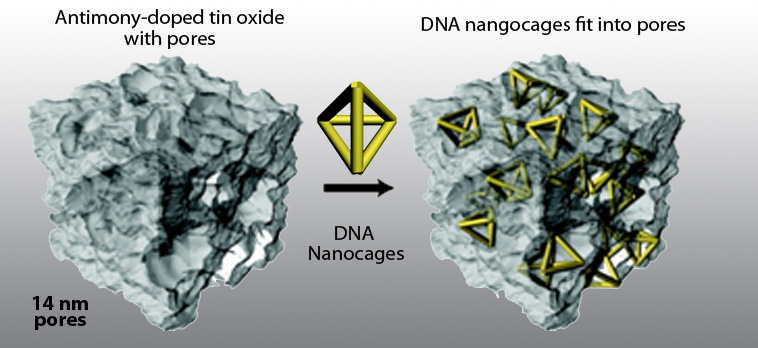
Researchers at the Center for Bio-Inspired Solar Fuel Production have successfully incorporated DNA-based nanocages into the pores of a transparent metal oxide material that conducts electricity while allowing sunlight to pass through it. The team is now significantly closer to constructing a transparent electrode with integrated catalysts, which is fundamental to developing a bio-inspired artificial solar fuel system.
Natural photosynthetic systems capture and store solar energy extremely efficiently. The Center is designing a bio-inspired solar fuel system that will efficiently convert solar energy and water into hydrogen for fuel cells. In plants, a water oxidation catalyst, the oxygen-evolving complex, uses energy generated through the excitation and removal of electrons by sunlight to catalyze the conversion of water into oxygen, hydrogen ions and electrons suitable for fuel production.
Making a transparent and porous conductor
In the bio-inspired solar fuel system, artificial water oxidation catalysts will use the electrical current generated by the flow of excited electrons through a conductive material (electrode) to convert water into hydrogen, which can be stored as fuel. The conductive electrode material must be transparent to allow sunlight to pass through it and excite the electrons. It may be “doped” with another element to facilitate electron removal. It must also be highly porous to hold sufficient materials to absorb all the sunlight and/or sufficient catalysts for water splitting. Antimony-doped tin oxide or ATO is a well-known transparent conductor, but has been available only in planar, non-porous forms with low surface area. Center researchers have developed a new ATO-based electrode material with three-dimensional interconnected pores of tunable size.
Using DNA nanocages
In the bio-inspired solar fuel system, the artificial catalysts will be optimally positioned within a matrix of this ATO conductive electrode material. The efficiency of the reaction that splits water will depend upon the proximity of the catalysts to the conductive material. To control this, the researchers aim to incorporate the artificial catalysts into the nanopores of the transparent electrode material using three-dimensional tetrahedral DNA nanocages. DNA nanocages are particularly suited for use as nanoscale scaffolds because DNA is highly programmable and DNA nanocages can be orientated with nanometer precision.
In this study, researchers at the Center investigated the ability of these interconnected pores within the ATO electrode material to size selectively, and efficiently, adsorb the DNA nanocages. These cages were incubated with narrow porous ATO materials, average pore size about 7 nanometers, and broad nanoporous ATO materials, average pore size about 14 nanometers. Fluorescent confocal microscopy was then used to demonstrate that the DNA nanocages had not been incorporated into the narrow nanoporous ATO material but had been incorporated into the broad nanoporous ATO material with high affinity. A Förster resonance energy transfer or FRET test demonstrated that the DNA nanocages did indeed maintain their integrity, remaining intact and stable within the nanoporous matrix.
The stable and efficient incorporation of DNA nanocages within the transparent ATO electrode material offers the potential for using DNA nanocages to integrate, and optimally position, artificial water oxidation catalysts within the transparent electrode and thereby maximize the efficiency of the conversion of water and sunlight into hydrogen fuel. This work represents a significant step forward in the development of a bio-inspired artificial solar fuel system.