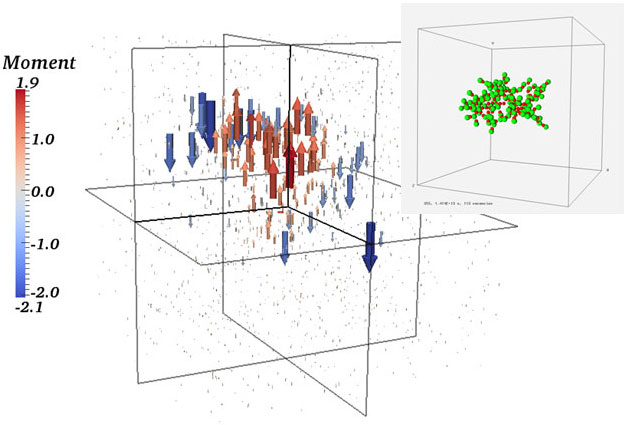
Iron, in its role as a key building material of nuclear fuel containers, must withstand both natural forces from the outside and large amounts of radiation from nuclear reactions on the inside. In the past year, after the tragic earthquake and subsequent nuclear disaster that struck the Fukushima prefecture on the east coast of Japan, it has become obvious that understanding the integrity of these housing structures is absolutely essential to guaranteeing the safety of local populations. Using advanced simulation techniques, researchers in the Center for Defect Physics in Structural Materials have modeled the evolution of a radiation-induced defect in iron. These predictions enrich existing knowledge about the fundamental properties of iron and will help engineers design safer and more robust structures in the future.
Magnetism in iron
Individual iron atoms align and distribute themselves in particular ways to give bulk iron its well-known magnetism. This magnetism influences many mechanical characteristics of iron, including its durability and brittleness. The Center is taking advantage of the leaps made in simulation science and computing power to study the evolution and consequences of atomic-scale defects in the magnetic signature of iron as a result of the radiation released during nuclear reactions. Such simulations have been performed, but never with the inclusion of temperature effects, which have the potential to have a large influence on the outcome of radiation-induced defects.
Modeling defect evolution with atomic-scale simulations
By imposing a set of conditions on a group of atoms and modeling the resulting dynamics, the response of a material to these conditions can be determined at the most fundamental level.The temperature dependence of the radiation-induced defect formation has not been previously theoretically modeled. Including the effects of temperature on the material shows how lattice vibrations and the volume of the lattice, properties which are both highly temperature dependent, affect the magnetic state of the iron. By adding this dimension to the simulation of radiation-induced defects in iron, a more complete understanding of these effects is possible.
Lasting defects in iron due to radiation
The simulations performed for this study show that when iron is struck by radiation, there is a momentary disruption in the typical magnetic distribution of the material. The magnitude of this disruption turns out to be highly temperature-dependent. Although this momentary fluctuation from the normal magnetic distribution eventually relaxes, the material undergoes certain lasting structural defects, most notably the formation of vacancies in the normal lattice of iron. These results have previously been observed experimentally. Further study is necessary to fully understand the implications of this result, according to lead author Yang Wang. He adds, “[in time], this study will give guidelines for building a better theoretical model for magnetic materials.”