For the first time, atomic layer deposition was used to synthesize nanoparticle catalysts that contain two metals: ruthenium and platinum. ALD has already been commercialized by the semiconductor industry and is easily transferable to the energy production industry as a way to fabricate catalysts.
Scientists led by Jeffery Elam with the Institute for Atomic-efficient Chemical Transformations published their multidisciplinary approach for designing and characterizing ruthenium-platinum nanoparticles in Nano Letters.
Catalysts facilitate chemical transformations and are essential for converting energy feedstocks into useable, clean energy. For instance, platinum catalysts in direct methanol fuel cells convert methanol into hydrogen fuel for electric vehicles. Mixing ruthenium in the platinum catalyst increases performance. “Improved ruthenium-platinum nanoparticle catalysts will accelerate the deployment of methanol-powered electric vehicles,” says Elam.
Unlike other catalyst synthesis methods, ALD has atomic-scale control during nanoparticle growth. “This ability to engineer catalytic nanoparticles at the atomic level will have tremendous benefits for clean energy technologies,” says Elam.
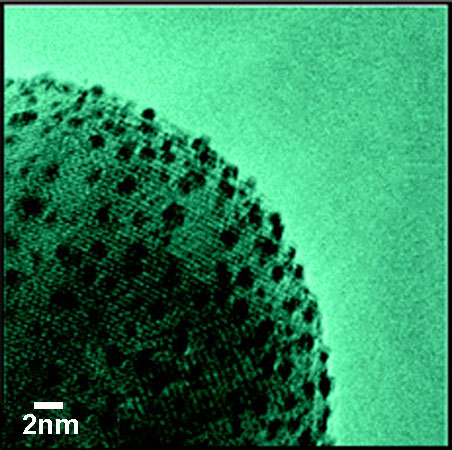
Learning about nanocatalysts: Institute scientists alternately deposited ruthenium and platinum atoms onto a nanoporous support using ALD. A quartz crystal microbalance verified growth during deposition, and electron microscopy revealed discrete ~1.2-nanometer metal nanoparticles.
Improved catalytic performance is achieved only when platinum and ruthenium are mixed at the atomic scale. To determine this, the team turned to one of Argonne’s unique facility resources: the Advanced Photon Source. Using synchrotron radiation, the scientists analyzed the nanoparticles’ x-ray absorption spectrum and were able to tease out two distinct chemical bonds: ruthenium-ruthenium and ruthenium-platinum. This confirmed that the nanoparticles were bi-metallic.
At temperatures above 210 °C, ruthenium-platinum nanoparticles yielded higher methanol conversions, up to 45% higher, than a single mixture of the two metals. This better catalytic behavior further supports the bi-metallic nature of the particles.
Future work: With the support of IACT, the group is investigating the ALD synthesis of other bi-metallic catalytic systems. They are also focused on resolving the nanoparticles’ inner atomic structure, hoping the understanding leads to more efficient catalyst design.