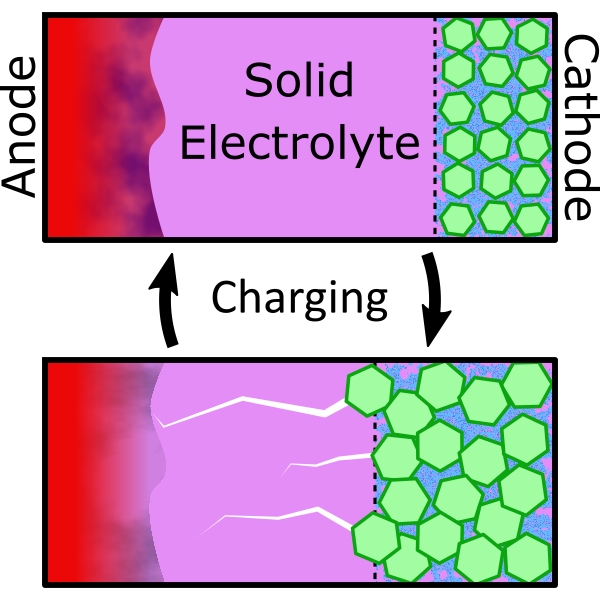
During operation, the internal parts of a rechargeable battery can experience high levels of stress as ions are moved between the anode and cathode within it. This pushing and pulling of charge inside the battery causes the anode and cathode to alternately swell and contract, and in part, leads to battery failure. Researchers in the Nanostructures for Electrical Energy Storage (NEES) Energy Frontier Research Center wanted to study how this compressive stress affects the battery, to identify the signs of failure before the battery actually breaks. To achieve this, they developed a new technique called pascalammetry that allowed them to carefully build and monitor a microbattery under stress.
In the pursuit of higher capacity rechargeable batteries, scientists have investigated an enormous number of new anode and cathode materials that store energy. While there are many desirable properties for battery materials, a critical one is the amount that the volume of the material changes due to the insertion or removal of lithium during charge or discharge.
All energy storage materials expand somewhat, but the ones that can store the most energy typically have very large volume expansions, upwards of 300 percent for silicon, one of the highest capacity materials known. Within the confined space of a battery casing, this incredible change in volume will push against the adjacent materials and may cause them to crack or weaken over time. This is especially damaging to the electrolyte, which sits between the anode and cathode and is responsible for preventing short circuits in the battery.
With this in mind, researchers at NEES began by devising a technique that could accurately measure minute changes in the electrical properties of battery materials. They tested their newly developed pascalammetry by placing a microneedle covered in lithium and lithium oxide (the anode and electrolyte, respectively) in contact with a thin film of silicon (the cathode). This setup yields a simple microbattery.

When they first applied a voltage to this microbattery, a small current flowed through it until it was charged to the correct voltage and then the current stopped itself. The team observed that by pressing the needle further into the cathode and compressing it, more current would begin flowing through the already charged battery. If the pressure is released, the current stops, but it restarts every time the battery is compressed. Their conclusion was that the compressive stress was temporarily creating extra pathways and releasing more ions to flow through the electrolyte.
The pascalammetry developed at NEES provides a precise means of measuring this stress-related current and allowed them to calculate how stress from the expanding cathode affects the flow of ions through the electrolyte. With these new measurements, the team explained this phenomenon by expanding upon pre-existing equations that were proposed in the 1980s.
Research into new battery technologies is trending towards the use of materials that are much stiffer than current options, which could lead to more chances for batteries to be damaged by volume expansion. With this new technique and associated equations, battery engineers have a concrete way to identify the signs of high stress in their batteries, which could lead to new designs that can prevent this kind of battery failure. In addition, this will enable researchers to predict in advance how different materials will behave when placed in a real battery, where stress can come from a variety of sources.