Energy is an integral part of our everyday lives, from when we use electricity to turn the lights on in the morning to the gas we use to drive home at night. Much of the energy we use is stored in the form of non-renewable resources, such as fossil fuels. Extracting fossil fuels for our use can be harmful to the environment. A promising way to store energy is in the form of hydrogen fuel, which can be made through a chemical reaction which splits water molecules into hydrogen and oxygen, which are environmentally benign. At the Center for the Computational Design of Functional Layered Materials (CCDM), an Energy Frontier Research Center, experimentalists are working with theorists and studying new catalysts to help make hydrogen production more efficient and cost-effective.
A catalyst is used to make a chemical reaction easier -- think about a chemical reaction as a hill over which you’re trying to ride a bike. If the hill is small, you can ride over it faster and easier. A catalyst helps decrease the hill for a chemical reaction. When used in water-splitting reactions, catalysts can lower the voltage, also called decreasing the overpotential, needed to drive the electrochemical conversion of water into hydrogen (called a hydrogen evolution reaction). The best catalyst for this reaction is platinum, which is scarce and expensive. As an alternative, scientists at CCDM investigated an Earth-abundant, low-cost material called molybdenum disulfide (MoS2). It has potential to be a substitute for platinum, but it needs further improvement before this can become a reality.
To improve the ability of MoS2 to produce hydrogen, it is necessary to tune its electronic and structural properties. This material is a flat sheet made of layers, and one way to change it is by inserting ions between the individual MoS2 layers in a process called intercalation. The fundamental layered structure stays the same, but the added ions can enhance properties needed to increase the catalytic activity of MoS2. Two research teams looked at different intercalation chemistries to boost hydrogen production.
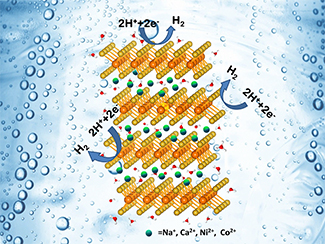
One team altered the interlayer region of MoS2 by intercalating different metal ions, including sodium, calcium, nickel, and cobalt. They found that these ions decreased the overpotential needed for the hydrogen evolution reaction. They postulated that at least one reason may be the ions reduce the surface charge on the MoS2 nanosheets and increase accessibility of active sites for hydrogen adsorption, which is a process by which hydrogen atoms stick to the catalyst surface. Moreover, the change induced by the metal ions favors the ideal binding energy for protons (hydrogen ions with a positive charge), which is a crucial value for a hydrogen evolution catalyst. The investigators also found that inserting the ions increased the electrochemically active surface area, which increased the amount of reaction sites and, thus, enabled more efficient production of hydrogen.
In a different study, a CCDM team looked at the effect of intercalating protons into MoS2 on catalytic activity using two methods. One method utilizes electrochemical treatments in acidic solution; the other consists of direct immersion of MoS2 in a super acid solution. The proton intercalation can happen either between the MoS2 layer and the support beneath the sample or between individual MoS2 layers. Interestingly, proton intercalation decreases the overpotential needed to create hydrogen, similar to the metal ions in the previous study.
This research is important, because after intercalating the proton, the catalytic ability for the hydrogen evolution reaction is enhanced in mildly alkaline and neutral solutions (which generally have fewer protons), not just acidic solutions (which have an abundance of protons). This property is crucial for future study, because the reaction coupled to hydrogen evolution is oxygen formation and that reaction usually requires a more basic or neutral solution.
Another powerful addition to both works is that CCDM utilized density functional theory calculations to support and expand upon their experimental results. These calculations show lower free energy of proton binding for all MoS2 samples with intercalated ions. These results indicate an improvement in hydrogen evolution reaction activity for both chemical treatments of MoS2 reported. The demonstration of calculated results that support experimental outcomes in two separate studies with different MoS2 chemistries highlights the utility and importance of complementing lab-based research with computational studies.
Through a combination of experimentation and computation, these researchers have elucidated effective ways to alter two phases of MoS2 catalysts to improve hydrogen production. While the overpotential for hydrogen evolution is still higher than that of platinum, the methods in these works demonstrate significant improvements.
Graduate student Nuwan Attanayake said, “Our work used cheaper alternatives that would potentially be more economically feasible in a real-world application. We believe that confinement of active metal cation species in the interlayers of MoS2 may be one of the effective strategies to move further with MoS2.”