Just look around: bottles, cups, furniture. We use plastics every day. Researchers at the Inorganometallic Catalyst Design Center have discovered a new material that can efficiently transform propane into propylene, a key component of the common plastics around you.
Propylene has a broad variety of applications in industry. In 2013, the United States alone used more than 14 million tons of it! However, the typical industrial methods to obtain propylene are not very energy efficient. First, propylene is produced along with many other products with very low yield; second, the process requires temperatures as high as 650 °C or 1,200 °F. As an alternative, the addition of oxygen in the propane feed helps decrease the temperature needed for synthesis, but the reaction still requires a material to make the system more efficient. Here is where metal-organic frameworks, a.k.a. MOFs, make their entrance.
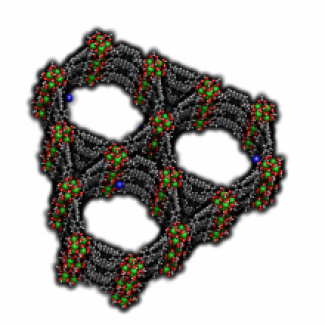
Versatile sponges. MOFs are a family of materials in which metallic centers are connected by organic molecules forming a 3D network. They contain large pores resembling those of a sponge. The MOFs can absorb and carry several times their own weight, so they can be used for gas storage and separation, detection of chemicals, and chemical reaction catalysis.
MOF catalysts coming to the rescue. One major application of MOFs is catalysis. A catalyst is a material that boosts the rates of chemical reactions, thereby making them more efficient and sustainable. Some reactions are not practical unless a catalyst is present. The activity of a solid catalyst usually depends on the amount of its surface that can be seen by the chemical reactants, such as propane. The use of highly porous MOFs tremendously increases the contact surface, such that each and every “hot spot” (catalytic site) can cause a chemical transformation.
There are a few known catalysts that, in the presence of oxygen, can transform propane (found in natural gas) into propylene (a valuable chemical), but their catalytic activity is low. However, by using a porous MOF to support cobalt oxides, scientists can prepare much smaller particles that could exhibit enhanced reactivity.
Just like a hundred marbles have more surface than one bowling ball, smaller cobalt oxides have larger contact surfaces. The particles are well separated in the MOF network, and that preserves the activity and lifetime of the catalyst. As a result, this new material can operate efficiently at low temperatures (for example, 230 °C or 446 °F) while maintaining a high and constant reaction rate for about 20 hours. Computational modeling has confirmed the experimental results showing that propylene is produced faster than other non-desirable products.
The first step of a long walk. This study provides a first step towards obtaining MOF-supported catalysts that are effective for low-temperature, more efficient, propylene production. Further optimization of these materials could ultimately affect the manufacture and pricing of everyday plastics. The impact of MOFs in daily life may soon be felt, with cheaper furniture, cups, and bottles possibly just around the corner!