

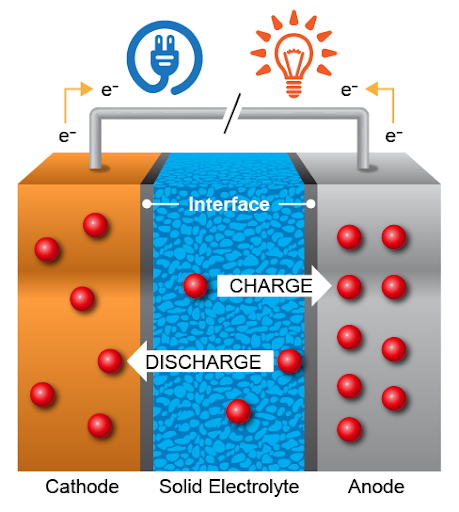
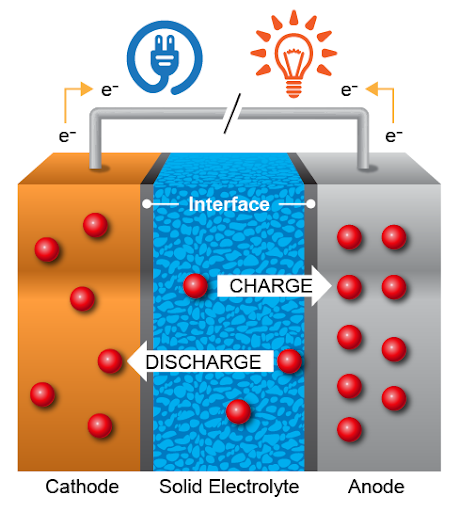
Interfacial structures are highly complex in nature, and their degree of complexity depends on factors such as interatomic bonding, lattice (or surface cell) mismatching, and atomic coordination at the interface. Understanding and tuning this interfacial complexity could lead to the design and tailoring of composite material properties for various applications, such as solid oxide fuel cells, nanocatalysts, thermal barriers, reducing corrosion of materials, building structural materials for nuclear reactors, and designing solid-state batteries. In general, a battery is a storehouse of various interfaces, and one crucial interface is the electrode–electrolyte interface. Engineering this interface is a crucial challenge toward realizing all-solid-state batteries (ASSB).
As the name suggests, "all-solid-state" means all electrochemical components are in a solid phase, which is the main difference from a conventional battery, where a liquid organic electrolyte is usually used. The high flammability and volatility of the liquid electrolyte is responsible for combustion risks, which is why we sometimes hear about exploding mobile phone, laptop, or electric vehicles batteries on the news. Despite their potential advantages—low flammability and high energy density—solid-state batteries with comparable electrochemical performance to conventional batteries have not yet been developed. One of the main reasons for this is high solid–solid interface resistance to ionic mobility between electrodes and electrolytes, which negatively influences battery performance. For example, imagine that your designed interface is slowing down the Li-ion transport from one electrode to another electrode through the electrolyte in the battery. One of the direct consequences of this incompatible interface will be a poor charge–discharge cycle of your battery, which means your battery would either discharge quickly or charge slowly. Therefore, understanding the role of interface design and moreover having a compatible interface design is the prime goal toward successfully realizing all-solid-state batteries.
There are many challenges in understanding complex interface design, especially on the atomic scale. The main theoretical challenge is the size of the atomistic simulation cell. Based on current computational resources, it is difficult as well as computationally expensive to accurately model a cell with more than 1000 atoms, which could be required to create, for example, a coherent interface. In addition, it is challenging to assign the same level of theory to treat the electronic properties of different phases of the interface. It is also experimentally challenging to understand interfaces design and structure using various characterization tools, such as atomic force microscopy (AFM), etc.
Scientists from the Fluid Interface Reactions, Structures and Transport (FIRST) Energy Frontier Research Center (EFRC) are addressing the challenges of interface research, especially how an interface’s design and its mechanical integrity alter the performance of batteries. In the FIRST EFRC, Prof. Kelsey Hatzell's team from Vanderbilt University studies “solid electrode-hybrid solid electrolyte” interface design and its mechanical properties, as well as the interface’s role in the electrochemical performance of ASSB to make it reliable in practical applications. The hybrid solid electrolyte is a combination of salt (inorganic oxide) and polymer–ion conductor, which get benefits from both the excellent transport properties of the salt and higher production scalability of the polymer. Hatzell's team considered polymers (poly(ethylene oxide) [PEO]) of three different molecular weights (300,000 g mol–1, 1,000,000 g mol–1, and 5,000,000 g mol–1) and Li7La3Zr2O12 (LLZO) and Lithium perchlorate (LiClO4) as salts to construct a series of the hybrid solid electrolyte. They observed that transport properties in each electrolyte were independent of the polymer molecular weight (MW), but electrochemical properties (such as stability and capacity, especially the cell performance) differed significantly with MW. Initially, they speculated that this variation either arises from the electrode as well as electrolyte microstructure or from the electrode–electrolyte interfacial properties. Later by employing various characterization techniques, they noticed that microstructure is independent of MW. Therefore, they concluded that the electrode–electrolyte interface must be responsible for differences in performance. The team’s electrochemical impedance spectroscopy depicted an inverse relationship between interfacial resistance and MW.
Certain properties help to describe an interface effectively, such as roughness, adhesion strength, and Young’s modulus (a measure of elasticity). By mapping these properties at the nanoscale (by AFM), Hatzell's team observed higher roughness for higher MW electrolytes and higher Young’s modulus for lower MW electrolytes. They also discussed the consequences of improved Young’s modulus. It lowers the dendrite formation and increases the stability and adhesion properties of the interface. A dendrite is a needle or whisker type structure at the interface of the electrode–electrolyte, which could be responsible for catastrophic failure of the interface, hence affecting overall battery performance.
Based on the experimental characterizations and theoretical model, Hatzell's team elucidated the correlation between the distribution of inorganic salt (LLZO) particles in the hybrid electrolytes and sub-surface microstructure and its role on interfacial mechanical properties. This study unveiled how proper control of micro- and nanostructures is possible by controlling the materials processing and chemistry, which eventually tailors the interfacial properties. This control is essential for the practical realization of long-lasting and safe ASSBs.